
Infrastructure architecture reflects the evolution of our societies
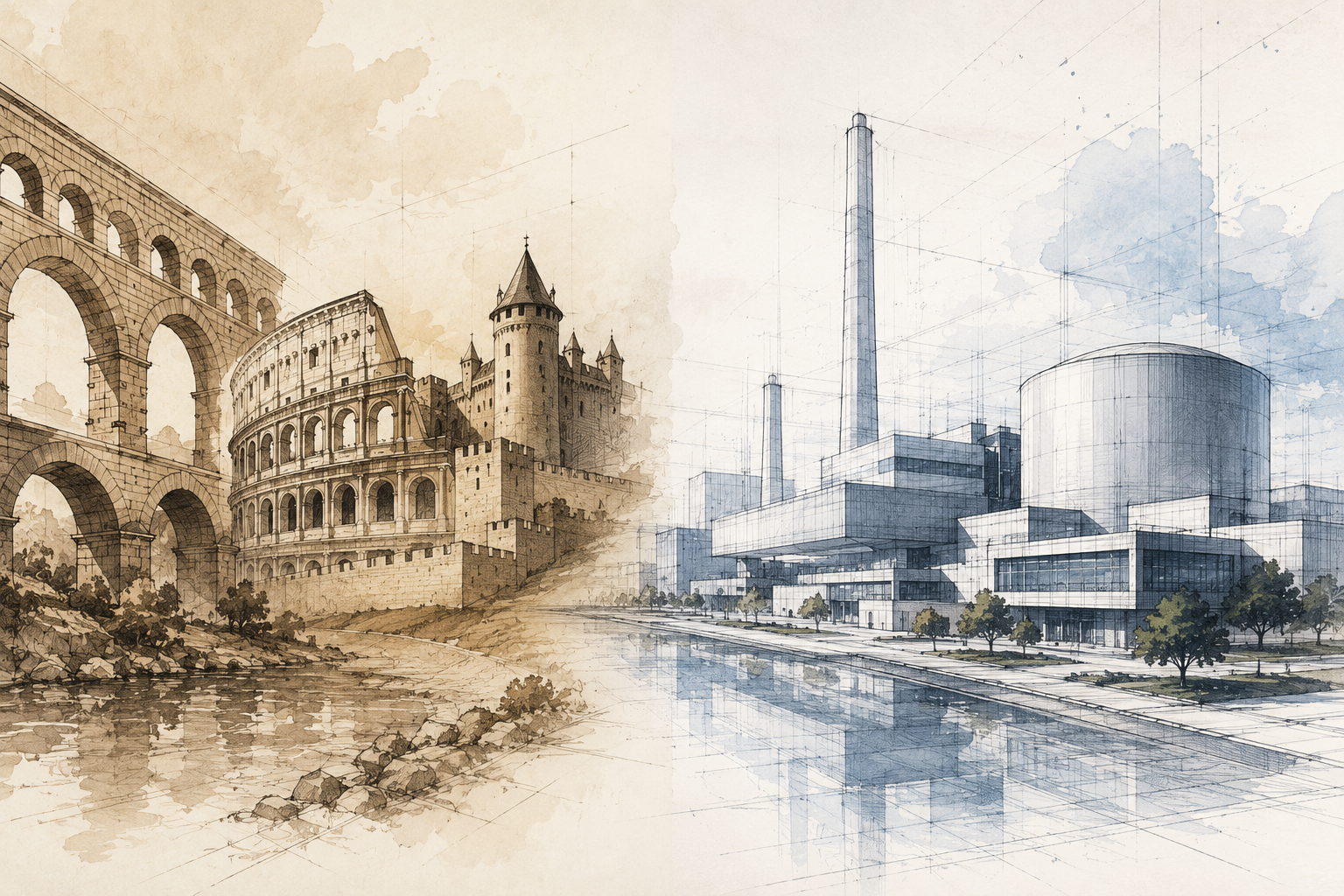
Discussions about Small and Advanced Modular Reactors (SMR, AMR) almost always focus on the technology: power output, fuel, safety, modularity, costs, and construction timelines.
However, at the SFEN General Assembly, a presentation by Brice Piechaczyk, an architect at ITER, introduced me to an aspect of nuclear energy that is discussed much less frequently: architecture.
This talk reminded me of a simple yet profound idea:
Infrastructure architecture reflects the evolution of our societies. Nuclear power is, after all, just one chapter in this story.
Infrastructure isn't just for production
By tracing more than two millennia of architectural history, Brice Piechaczyk shows that major infrastructure projects have always addressed three fundamental needs:
living together;
protect;
produce.
These three dimensions span the ages, regardless of the technologies used.
Building for a Shared Future
The Pont du Gard, the Colosseum, and the Chand Baori in India are not merely technical feats. They are structures designed to meet a collective need, while also creating a place for people to gather, interact, and live. They demonstrate that infrastructure can be useful, sustainable, and imbued with its own identity all at once.
Building to Protect
From medieval fortresses to the Château de Coucy, and including the walled city of Palmanova, the need for protection has always shaped the design of buildings. Architecture thus reflects the constraints of its time: protecting a territory, withstanding an attack, managing the flow of people, or ensuring the safety of the population.
Building to Produce
With the Industrial Revolution came a new category of infrastructure: factories. At first, they were designed primarily to maximize efficiency and enable mass production. Then, gradually, industrialists began seeking to give these buildings their own identity.
The Familistère de Guise, Le Corbusier’s works, the Hoover Dam, and certain CEA buildings illustrate this evolution: industrial architecture is no longer merely functional but has also become a language—a way of expressing a vision of industry and progress.
ITER: When Architecture Supports Science
This project is often discussed in terms of its scientific and technological challenges. Yet it also embodies a genuine architectural ambition.
Brice Piechaczyk explained that an architectural charter had been developed for the site to integrate the installation into its Provençal surroundings, with mirrors reflecting Cézanne’s mountains.
This approach serves as a reminder that a major scientific facility is more than just its function. It is rooted in a specific region, interacts with its surroundings, and helps shape the landscape around it.
SMRs: A New Chapter to Be Written
Their small size, modular design, and the variety of potential locations raise entirely new questions.
How does an SMR fit into a natural landscape? How does it interact with a city? Should it stand out as a symbol of technology, or, on the contrary, blend into its surroundings?
These questions were at the heart of the recent architectural competition focused on SMRs, which recognized four complementary visions:
architecture that embraces the presence of the installation;
architecture that blends unobtrusively into the landscape;
a location in a dense urban environment;
A discussion on the future of these sites and their repurposing after they are no longer in use.
These projects demonstrate that architecture is not a secondary consideration. It plays a full role in the acceptability, regional integration, and identity of future energy infrastructure.
Another Way to Look at Nuclear Power
As a nuclear instrumentation engineer, I have long viewed facilities through the lens of physics, detectors, measurements, and safety. This conference reminded me that industrial infrastructure is also a cultural artifact. It shapes a region, supports a society’s practices, and reflects a certain vision of progress. Ultimately, SMRs will not merely be a technological innovation. They will also represent a new way of shaping our energy landscape.