
My new coworker's name is Claude
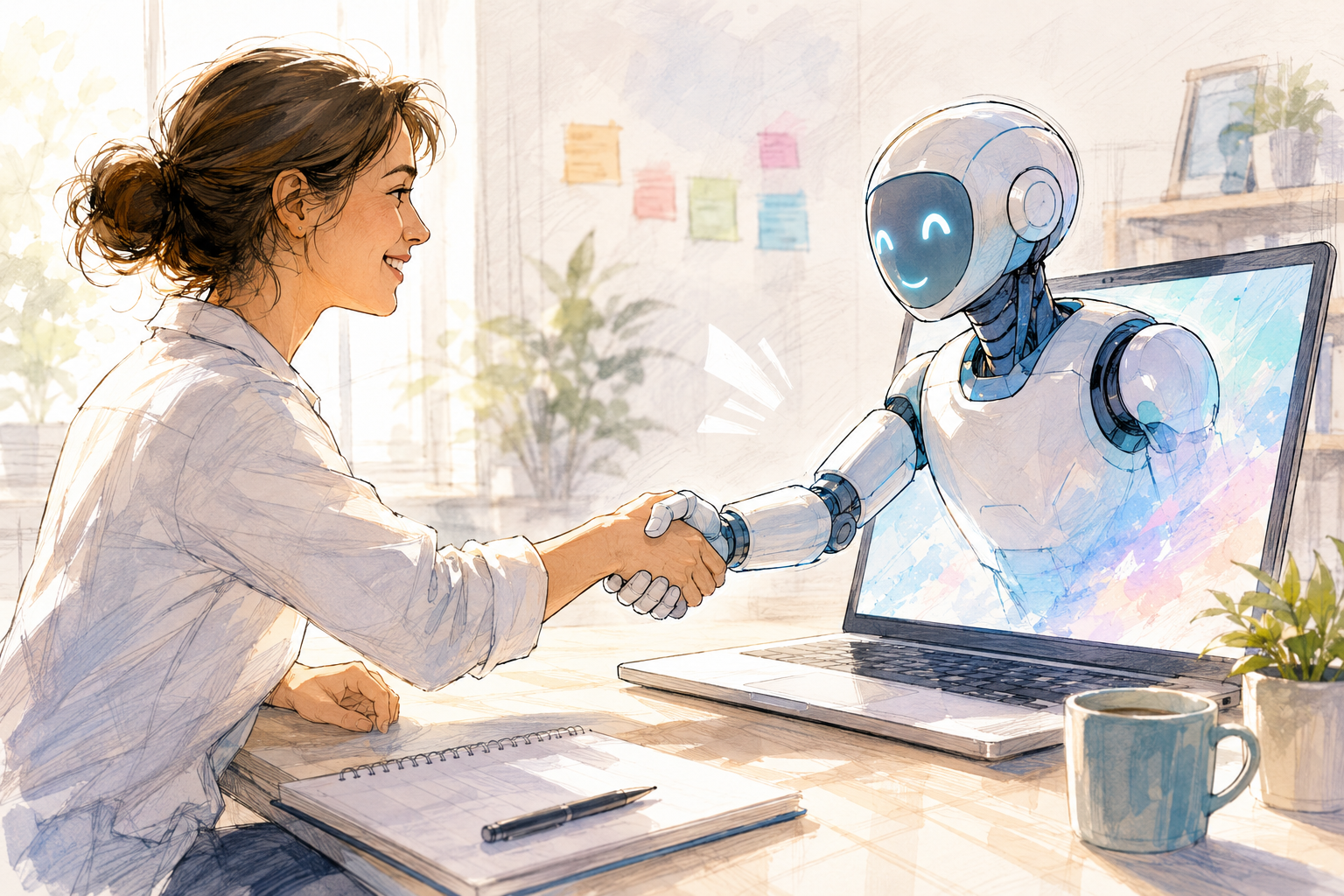
For some time now, a new coworker has been intriguing me.
His name is Claude. He doesn't drink coffee, never books a meeting room, and seems relatively available when asked to take over an analysis at 10 p.m.
On paper, the profile looks promising.
But behind the touch of humor lies a real R&D question: What can an artificial intelligence agent actually contribute when paired with scientific simulation software like OpenMC?
Not for writing a paragraph or summarizing a document. For working directly on a digital study.
From Chatbot to Computational Agent
When we talk about generative artificial intelligence, we often think of an interface where you ask a question and get an answer. But these tools are evolving rapidly.
With an agent capable of accessing a development environment, reading files, modifying code, and executing commands, the logic changes.
Let's imagine an OpenMC project that has already been set up. A reference case describes an absorbing disk containing boron that is exposed to a neutron beam. The geometry, materials, source, and tallies are defined. A post-processing script is used to extract the results and generate the figures needed for analysis.
Of course, I can run this simulation, retrieve the results file, and analyze the relevant parameters.
But what happens if I ask Claude, “Study the effect of the thickness of the absorbent disc, ranging from 1 to 5 cm.”
This is where the potential gets interesting.
A nearly autonomous parametric study
If the project is properly prepared, Claude can theoretically follow the entire calculation process:
Identify the parameter corresponding to the disc's thickness;
generate the various calculation scenarios;
change the OpenMC model settings;
run the simulations one after another;
check for the presence of the output files;
run the post-processing script;
extract the defined physical quantities;
compare the results with the reference case;
create the figures;
summarize the trends observed.
In other words, AI no longer merely explains how to conduct a parametric study; it can potentially carry it out.
For anyone who has ever spent a few hours creating geometry variations, renaming folders, and rerunning nearly identical calculations, the idea is at least worth considering.
But Claude isn't a magician
There is, however, one essential condition: Claude must have a work environment that he can understand.
In the case of OpenMC, this means having a properly structured reference project—which then plays a fundamental role.
It defines the physics of the problem and, above all, how the results should be analyzed.
Claude doesn't need to "guess" what a correct simulation looks like. He can start with an existing method and apply that logic to the various parametric variations.
This is an important distinction. Intelligence does not come solely from the agent. It comes from the quality of the scientific environment provided to the agent.
The Symbiosis Between Researchers and AI
This is probably where I see the most interesting potential for R&D.
The researcher or engineer defines:
the physical aspect;
the assumptions;
the range of variation of the parameters;
the relevant quantities;
the comparison criteria;
the physical validity of the results.
The AI agent can handle some of the repetitive tasks:
variant generation;
start the calculations;
organization of results;
standardized post-processing;
production of the first comparisons.
In a Monte Carlo study, this division of roles can be particularly powerful. This allows more time to be devoted to the question that really matters: Why does the result change in this way?
An example: the boron absorber
An absorbent disk is placed under a neutron beam. The material contains boron, whose isotopic composition can vary between natural boron and boron enriched in boron-10.
Several parametric studies can be considered:
effect of disc thickness;
the effect of incident neutron energy;
variation in the boron-10 fraction;
comparison of several absorber compositions;
comparison of reaction rates;
Changes in the transmitted flow.
The OpenMC model allows for a precise description of the physics of the problem. Claude, for his part, can potentially manage the different versions of the model and apply the same analysis protocol to each simulation.
The combination of the two—a Monte Carlo code dedicated to particle transport, coupled with an agent capable of interacting with the entire numerical workflow.
What about human validation?
It remains essential.
A curve can be perfectly generated yet physically absurd. A calculation can converge numerically while still answering the wrong question. A tally can be read correctly but misinterpreted. And an AI can produce a very convincing explanation of a phenomenon that doesn't exist.
This is probably one of the main risks associated with these new workflows.
In a nuclear environment, traceability, verification, and validation become even more important with the advent of AI. The role of the expert is changing: he or she no longer verifies only the calculation, but also the automated process that generated and interpreted that calculation.
My Next Test
That is exactly the experiment I want to conduct: build a reference OpenMC case, define a reproducible post-processing method, and then ask Claude to carry out several parametric studies based on this foundation.
The goal will not be merely to compare the physical results. I want to compare two working methods:
a study conducted manually by a female engineer;
and the same study orchestrated by an AI agent.
Time required, reproducibility, errors, quality of post-processing, relevance of the analysis: Our colleague Claude will have to pass his probationary period.