
Nuclear Fusion: What Are the Alternatives to the Tokamak?
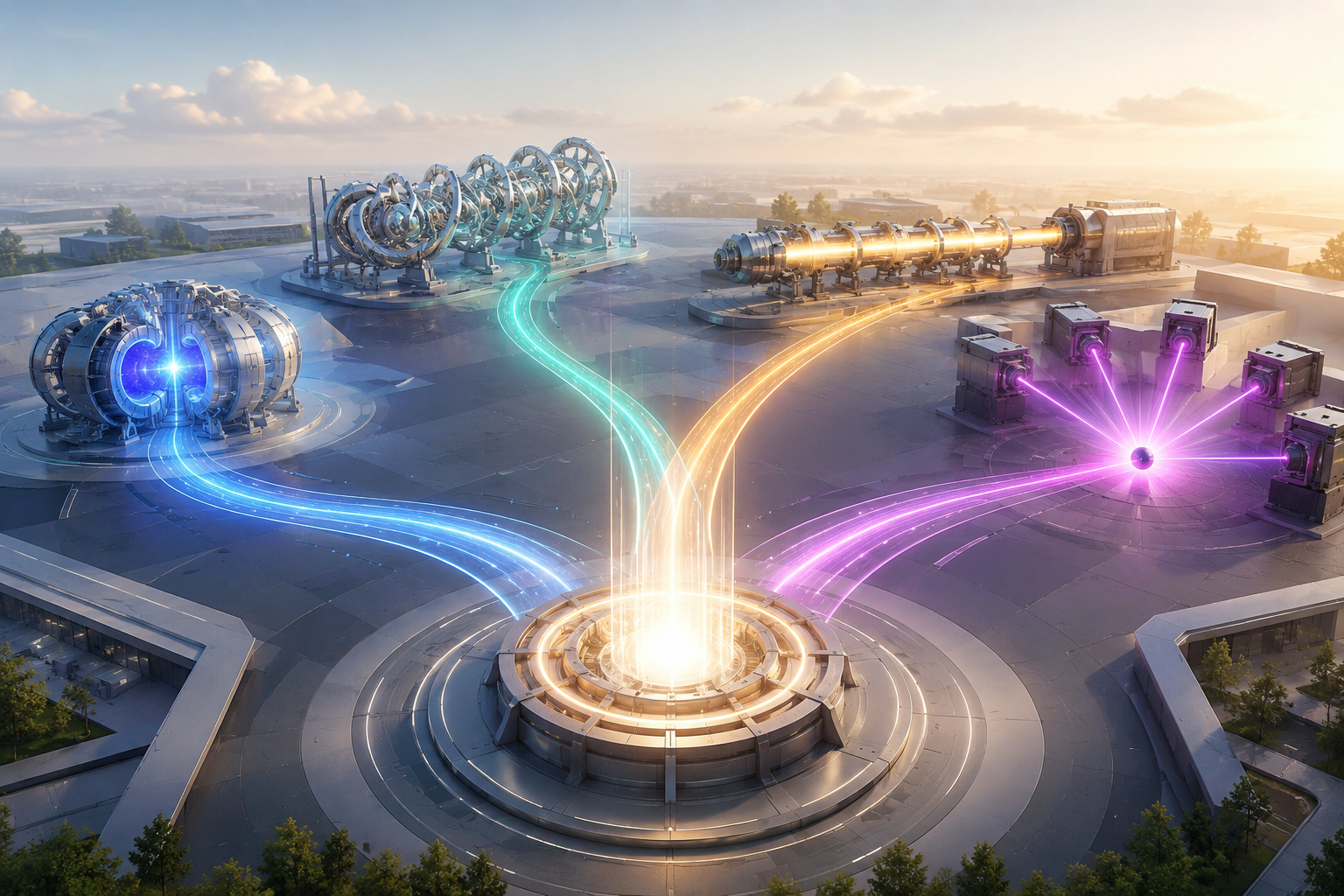
When we talk about fusion, the tokamak immediately comes to mind—that immense toroidal chamber surrounded by superconducting magnets. And when we say “tokamak,” we think of ITER. It is currently one of the most ambitious scientific and technological projects in the world. Its goal is to demonstrate the scientific and technical feasibility of fusion energy, with a target energy gain of 10.
ITER also helps us understand something essential: moving from plasma physics to an integrated facility requires balancing performance, materials, safety, maintenance, cost, and industrial feasibility. In fact, its design has continued to evolve since the initial studies in the late 1980s, in response to scientific advances as well as technical, economic, and regulatory constraints.
At the 3rd ITER Public-Private Fusion Workshop, which I attended last April, another fact particularly caught my attention: the tokamak is far from being the only technology being explored to achieve nuclear fusion.
The parallel with fission is quite obvious. When people talk about AMRs today, certain technologies receive much more media attention than others. Yet behind the term “Advanced Modular Reactor” lies a wide range of very different concepts. It’s the same story with fusion.
Several Paths to Fusion
Regardless of the technology under consideration, the fundamental physical challenge remains the same: creating the conditions that allow light nuclei to fuse and maintaining those conditions long enough to produce energy. It is in how to achieve this that the technologies differ.
There are two main strategies for organizing the system: magnetic confinement, in which powerful magnetic fields are used to contain the plasma, and inertial confinement, in which a small amount of fuel is compressed extremely rapidly. But even within these two broad categories, the architectures can vary.
The tokamak: ITER's flagship technology
The tokamak belongs to the class of magnetic confinement devices. It consists of a toroidal chamber in which plasma is confined by a combination of magnetic fields.
The significance of ITER goes beyond simply demonstrating plasma confinement. It requires integrating, within a single machine, plasma physics, superconducting magnets, components exposed to high thermal and neutron fluxes, tritium, cooling systems, diagnostics, maintenance, and safety.
The successive changes in ITER’s design are a good illustration of this complex problem. The initial objectives were gradually adjusted in light of cost, schedule, and technical feasibility. The shift from the initial goal of achieving ignition to the current goal of Q = 10 and 500 MW of fusion power is one example. The evolution of plasma-facing components is equally revealing: carbon, beryllium, and then tungsten have successively occupied different roles in the design as knowledge and constraints have evolved. Fusion technology is not merely a configuration capable of confining a plasma. It must be successfully turned into a machine. And then, a power plant.
The stellarator is the other well-known major family.
A closed magnetic confinement system has a 3D geometry that is very different from that of a tokamak and represents an alternative method of creating the magnetic configuration necessary for plasma confinement.
There are also open-field-line architectures, such as magnetic mirrors. The idea is not new: the plasma is confined longitudinally by stronger magnetic fields at the ends. The long-standing problem is how to prevent particles from escaping through these ends.
rethink the principle of magnetic mirrors
Novatron is seeking to develop a mirror-cusp architecture. The concept presented at the workshop combines three confinement mechanisms at the ends: magnetic, ambipolar, and ponderomotive. Beyond the confinement principle itself, the claimed advantage lies in the simplicity of the architecture: an axisymmetric, open, and relatively accessible geometry, designed for continuous operation.
In particular, this geometry could facilitate access to components and plasma compared to more complex closed magnetic architectures. It also opens up another interesting application—its use as a volumetric neutron source for material irradiation, with a large and accessible experimental volume.
This approach is still in the development phase, and its future performance, of course, remains to be seen. But it is interesting precisely because it shows that an alternative to the tokamak can be based on a completely different geometry and method of confinement.
Inertial Confinement Fusion: A Complete Shift in Strategy
With inertial confinement fusion, the approach changes yet again. It is no longer a matter of sustaining a plasma over a long period using magnetic fields. A small amount of fuel is subjected to an extremely rapid energy input in order to achieve, for a very short time, the conditions necessary for fusion reactions. Lasers are one possible approach.
And this approach raises yet another set of technological challenges: laser performance and efficiency, target fabrication, injection, shot repeatability, and energy recovery. Two major facilities currently exemplify this approach on the megajoule scale. In France, the Laser Mégajoule, designed and operated by the CEA, serves as the leading European facility. In the United States, the National Ignition Facility is its major counterpart. The French ecosystem continues to evolve. In 2024, Thales established GenF, with support from the CEA, the CNRS, and Polytechnique, announcing a preliminary design to be completed by 2027 and aiming to develop an industrial demonstrator in the longer term.
ultra-short lasers and nanostructured targets
The Marvel Fusion concept combines three key components: ultrashort-pulse lasers, nanostructured materials designed to improve coupling between the laser and the target, and non-cryogenic solid fuels.
Marvel Fusion showcased, among other things, nanowires approximately 50 nm in diameter and 20 µm in length, as well as the development of processes capable of fabricating more than 1,000 nanostructured targets on a silicon wafer. But simply demonstrating that a concept works physically is not enough. To envision a power plant, we must also be able to answer another question: Can the process be replicated thousands, then millions of times in a reliable and economically viable manner?
Magnets and Liquid Walls
The future of fusion could also depend on cross-cutting technologies capable of modifying multiple architectures at once. Two examples presented during the workshop illustrate this: HTS superconducting magnets and liquid metal walls.
HTS magnets—high-temperature superconductors (HTS)—are not fusion technology per se. However, they could become an enabling technology for several magnetic confinement concepts. The benefits are significant: higher magnetic fields make it possible to design more compact machines.
To build fusion magnets, it is necessary to be able to produce kilometers of material with sufficiently uniform performance and at a cost compatible with industrial use. This scale-up was presented by Faraday Factory. Its Japanese facility reports an annual production capacity of 3,000 km of 4-mm HTS ribbon, and the company is also developing high-current cables for tokamaks, stellarators, and open confinement systems.
The work presented by ASIPP (Institute of Plasma Physics, China) illustrates progress toward very high magnetic fields. Magnets using REBCO superconductors have been tested at fields exceeding 20 T, and a hybrid system combining REBCO and low-temperature superconductors achieved a central field of 35.1 T, of which 22.5 T was produced by the HTS component. The authors note, however, that longer-term validation over multiple cycles is still needed.
Another problem common to many architectures: what should go between the plasma and the rest of the machine?
In a future D-T reactor, components in close proximity to the plasma will have to withstand high heat fluxes and a particularly harsh neutron environment. One approach is to develop solid materials capable of withstanding these conditions.
Another approach involves… changing the very nature of the wall. This is the idea being explored by Renaissance Fusion with thick walls made of liquid metal. The concept is presented as potentially applicable to various D-T reactors.
The philosophy is to transform a solid mechanics problem into a fluid mechanics problem. A liquid wall could carry high heat flux densities, self-regenerate, contribute to neutron shielding, and—if it contains lithium—help produce tritium. But as is often the case in engineering, solving one problem gives rise to others.
It is necessary to understand the interactions between gravity, inertia, plasma, and magnetohydrodynamic forces, as well as the interaction with the magnetic field and lithium evaporation. Renaissance Fusion has built an experimental loop combining liquid tin at 700 °C and an HTS magnet operating at up to 0.6 T, separated by only 40 mm. Tests showed fragmentation of the high-current-density jet, which subsequently led to modifications in the flow guidance to achieve a continuous tin layer.
We do not yet know what architecture—or what combination of technologies—will be used in fusion power plants.
The question is no longer just how to create and confine a plasma. We must now succeed in transforming these concepts into energy systems. ITER is exploring, on an exceptional scale, one of the main paths toward fusion—but it is not the only possible path. Tokamaks, stellarators, mirror machines, inertial confinement… along with cross-cutting innovations such as HTS magnets and liquid walls: the technological landscape is much broader than the image we usually associate with fusion.
Burning plasma achieved in inertial fusion
Novatron: Equilibrium and Stability
Confinement performance predictions for a high-field axisymmetric tandem mirror